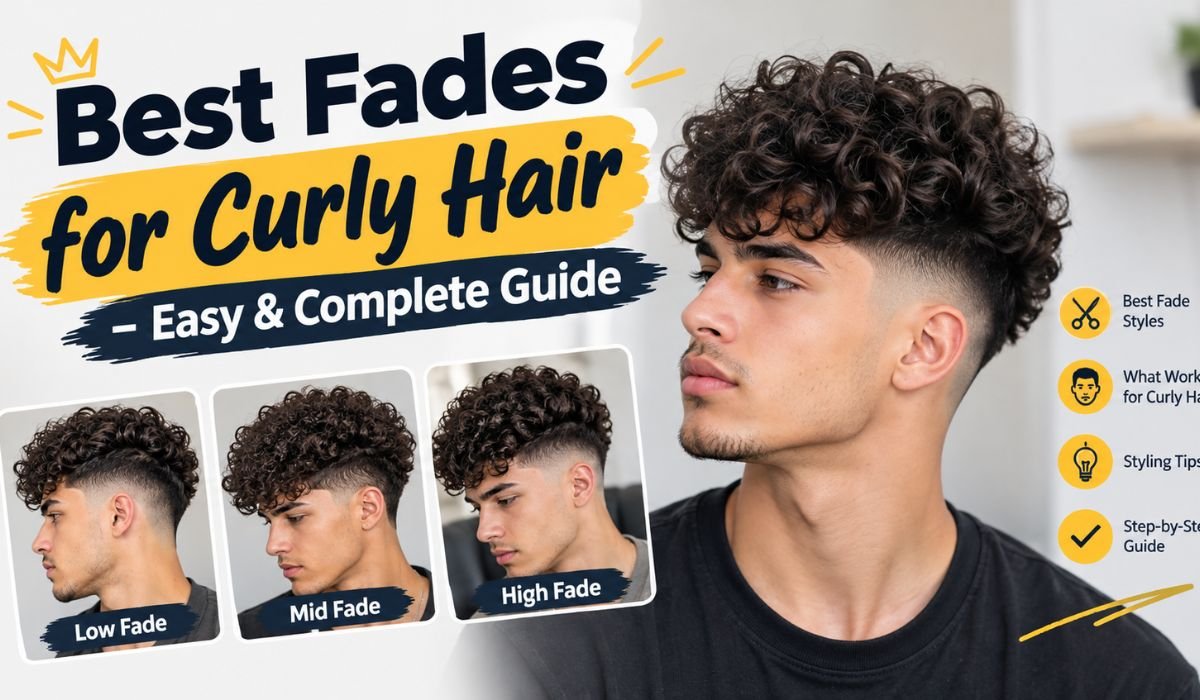
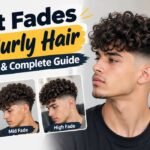
Curly hair grows outward, not downward. That single fact explains why so many curly haircuts end up looking wide, heavy, or shapeless after a few weeks. A fade fixes that. It cleans up the sides, controls the bulk, and pushes all the attention to the curls on top where it belongs.
This guide covers the most practical Fades for Curly Hair, with a clear focus on the two styles most men actually ask for: the low fade and the low taper fade. You’ll learn what each one is, how they differ, which curl types they suit, exactly what to say in the barber’s chair, and how to keep the cut sharp between visits.
No guesswork. No filler. Just the details that help you walk out with a haircut you like.
Why a Fade Works Well for Curly Hair
Curls stack on top of each other. That creates volume, and volume on the sides makes your head look wider than it is. A fade removes that width and gives the haircut a clean outline.
Here’s what a fade actually does for textured hair:
- Removes side bulk so the silhouette stays balanced
- Boosts curl definition by contrasting short sides against a full top
- Frames the face, softening a square jaw or adding height to a round face
- Cuts down styling time because there’s simply less hair to manage
- Keeps the neckline tidy, which is what makes a cut look “fresh”
This is why Fades for Curly Hair work across nearly every curl pattern, from loose 2C waves to tight 4C coils. The fade handles structure. Your curls handle personality.
One more point that matters: a fade works with your curl pattern instead of against it. You’re not straightening, thinning, or flattening anything. You’re just shaping the edges.
What Is a Low Fade for Curly Hair?
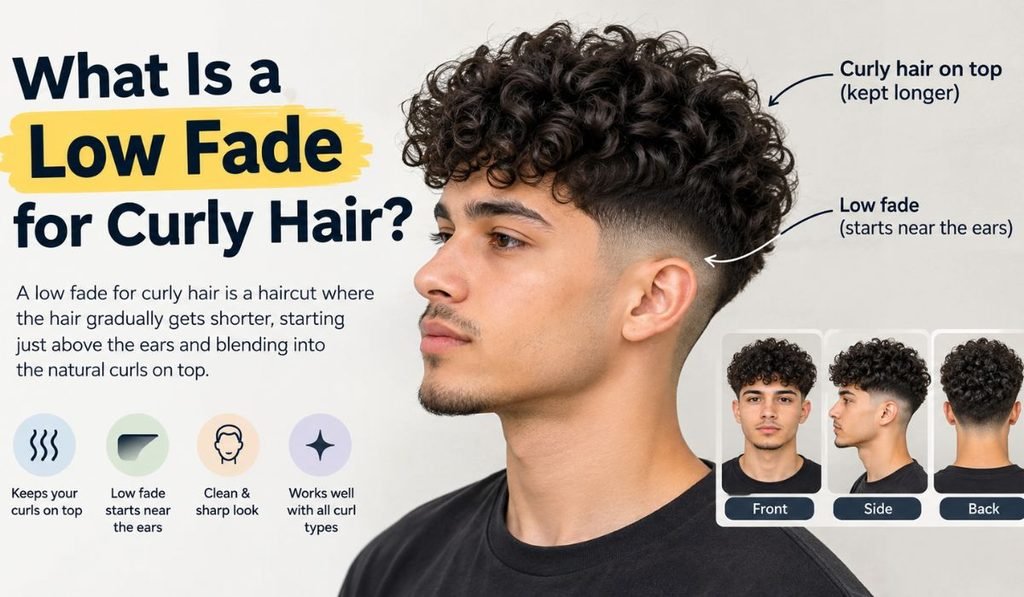
A low fade starts low on the head, usually about an inch above the ear and along the natural hairline. From there, the hair gets gradually shorter as it moves down toward the skin.
Key features:
- The fade line sits below the temple
- Most of the side hair stays intact
- The transition is short and sharp
- It can end in a very short guard or go all the way down to skin
Because the fade begins low, you keep plenty of length through the upper sides. That matters for curly hair, since the curls on top stay visually “connected” to the sides rather than sitting on a bare scalp.
A low fade is the safest entry point into Fades for Curly Hair. It’s subtle enough for offices and schools, but still reads as a real haircut rather than a trim.
What Is a Low Taper Fade for Curly Hair?
A low taper fade is softer and more limited. Instead of fading the entire perimeter, the barber tapers only specific areas: around the ears, the sideburns, and the back neckline.
Key features:
- Only the edges get shortened
- The rest of the side hair keeps its natural length
- The blend is gradual, not sharp
- No large exposed area on the sides
Think of it as a cleanup rather than a reshape. The low taper keeps your overall hair volume, which is a big advantage if you like your curls full or you’re growing them out.
Among all Fades for Curly Hair, the low taper is the most forgiving. It grows out evenly, it’s hard for a barber to get badly wrong, and it never looks too severe.
Low Fade vs Low Taper – Simple Difference
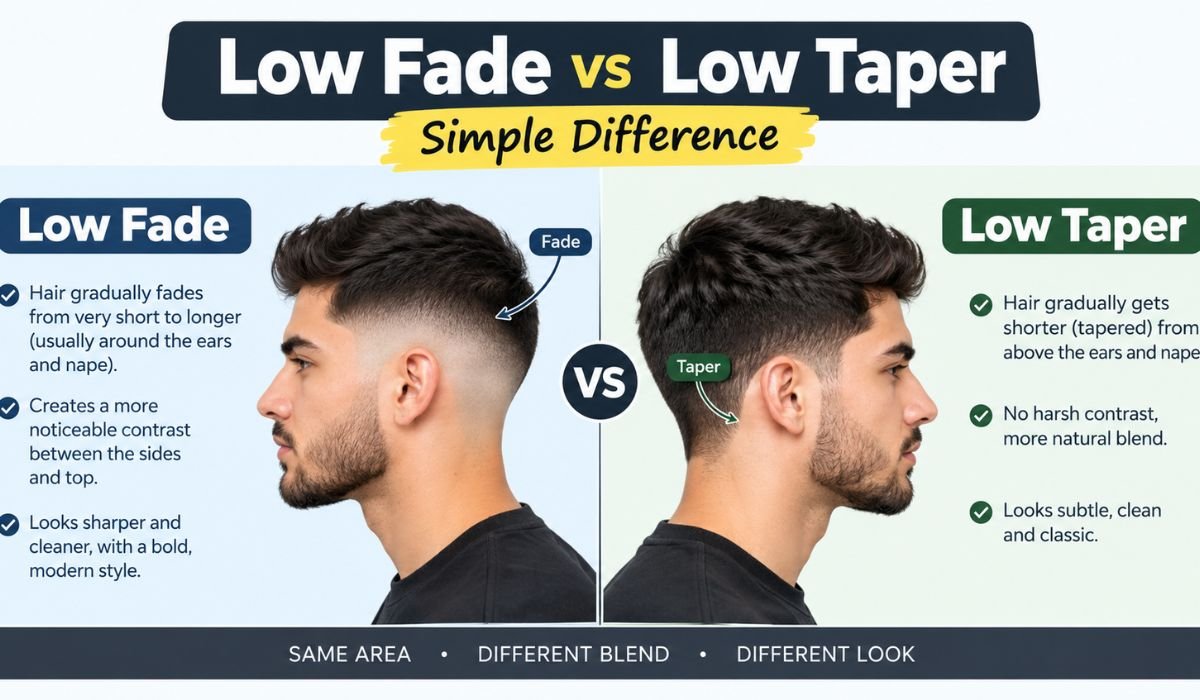
Both start low. The difference is how much hair gets removed.
| Feature | Low Fade | Low Taper Fade |
| Area cut | Full sides and back | Edges only (ears, sideburns, nape) |
| Contrast level | Medium to high | Low and soft |
| Look | Sharp, defined, modern | Natural, understated |
| Volume kept | Less | More |
| Grow-out | Visible line after 2–3 weeks | Blends out evenly |
| Barber visits | Every 2–3 weeks | Every 3–5 weeks |
| Best for | Guys who want contrast | Guys who want a clean, natural shape |
| Beginner friendly | Yes | Yes, even more so |
Quick answer: A low fade removes more hair and creates more contrast. A low taper only cleans up the edges and keeps your curls looking full.
If you’re still deciding between the two Fades for Curly Hair, go by how much change you want. Low fade for a noticeable reset. Low taper for a subtle refresh.
Read Related Post: Best Fades for Curly Hair – Easy & Complete Guide
Best Low Fade Styles for Curly Hair
These are the low fade variations that pair best with real curl texture.
1. Low Fade with Curly Top
The standard. Short faded sides, curls left long enough to fall naturally on top. Works for 2C through 4A. Ask for 2–4 inches on top depending on your shrinkage.
2. Low Drop Fade
The fade line curves downward behind the ear instead of running straight across. That curve follows the head shape and rounds out a boxy silhouette. Excellent if you carry heavy volume up top.
3. Low Skin Fade with Curls
The fade goes down to bare skin at the bottom. Maximum contrast, sharpest look. Best on thick or coarse curls, since fine hair can look patchy. Needs a touch-up every two weeks.
4. Low Burst Fade
The fade arcs around the ear in a半 circle shape and leaves the back length alone. Popular with curly mohawk shapes and mullets. Highly recommended for coily textures.
5. Low Fade with Curly Fringe
Curls pushed forward over the forehead with faded sides. Softens a high hairline and works well on oval and long faces.
6. Low Fade with Line Up
A low fade finished with a straight razor edge across the hairline. Adds definition and makes the curls look intentional rather than grown out.
These six cover most of what people mean when they search for the best Fades for Curly Hair in a barbershop setting.
Best Low Taper Fade Styles for Curly Hair
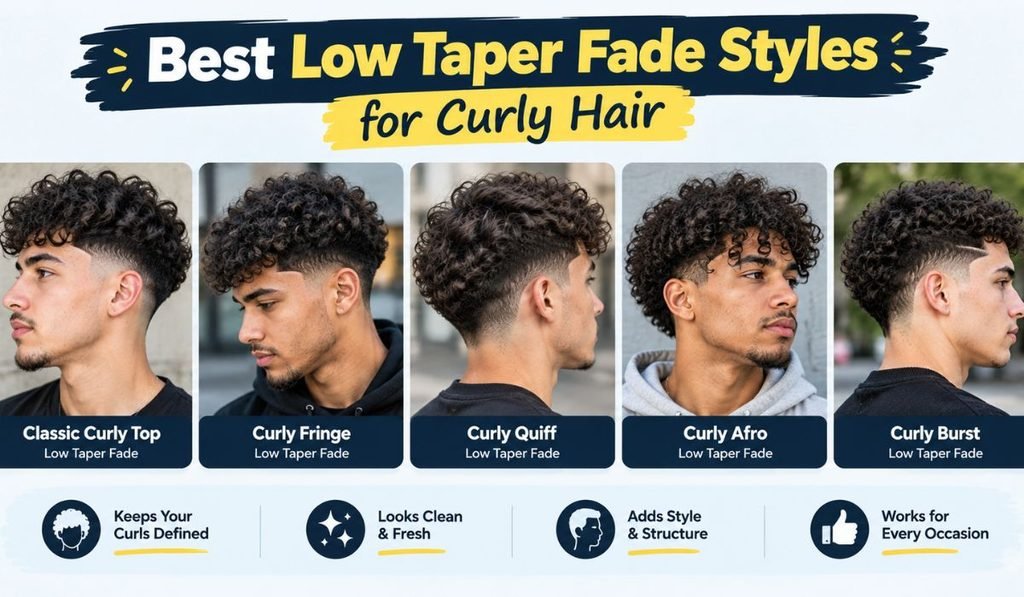
The low taper keeps things soft. These are the versions worth asking for.
1. Classic Low Taper with Natural Curls
Edges cleaned, everything else untouched. The most low-maintenance option available.
2. Low Taper with Curly Afro
Height and roundness stay on top, but the neckline and sideburns stay sharp. A clean way to wear volume.
3. Low Taper with Middle Part Curls
Curls parted down the center with tapered edges. Currently one of the most requested looks for 2C–3B hair.
4. Low Taper with Twists or Sponge Curls
Works with twist-outs, finger coils, and sponge-defined curls. The taper stops the style from looking bottom-heavy.
5. Low Taper with Beard Blend
The sideburn tapers directly into the beard line. Connects the whole face and looks polished without much effort.
Low Taper for 3C / Coily Hair:
3C hair is tight, springy, and shrinks a lot when dry. That shrinkage is exactly why the low taper works so well here.
What to keep in mind:
- Cut on damp, stretched hair. Dry 3C hair hides its true length and barbers can easily take off too much.
- Keep the taper gradual. A harsh line against dense coils creates a visible “step.”
- Leave 2–4 inches on top. Shrinkage will make that look shorter than it is.
- Ask for a soft blend, not a sharp one. Coily texture already provides contrast.
- Skip heavy thinning. It disrupts curl clumping and creates frizz.
For 3C and 4A textures, the low taper is often a better daily choice than a full fade. It needs less upkeep and grows out without an obvious line.
Choosing the Best Fade by Hair Type
Your curl pattern should drive the decision more than any trend. Use this as a starting point.
| Curl Type | Texture | Best Fade | Why It Works |
| 2B–2C (Wavy) | Loose S-waves | Low taper fade | Keeps waves from looking flat |
| 3A (Loose curls) | Large, soft curls | Low fade | Adds definition to soft texture |
| 3B (Springy curls) | Tight ringlets | Low fade or drop fade | Controls side width |
| 3C (Tight curls) | Corkscrew coils | Low taper fade | Handles shrinkage and density |
| 4A–4B (Coily) | Dense, compact coils | Low taper or burst fade | Natural blend, less breakage risk |
| 4C (Tight coils) | Zigzag pattern | Low skin fade or taper | Strong contrast, easy upkeep |
Face shape matters too, but less than most articles claim:
- Round face: Keep more height on top, go with a low fade
- Square face: Low taper softens strong jaw lines
- Oval face: Almost anything works
- Long face: Avoid too much height; a fringe balances it
Best Fade for Daily Life
If you want one answer that fits most people, most of the time: the low taper fade.
Here’s the reasoning:
- It looks clean at work, school, and events
- It lasts 3–5 weeks before it needs attention
- It doesn’t expose scalp, so it suits every hair density
- It grows out evenly instead of leaving a hard line
- It costs less over a year because you go less often
Choose a low fade instead if you want visible contrast, you like a sharp look, and you don’t mind a barber visit every 2–3 weeks. Both are excellent Fades for Curly Hair. The taper is simply easier to live with.
How to Tell Your Barber:
Clear instructions get you a better cut than any style name. Use this script:
- “I’d like a low taper fade, starting just above my ears.”
- “Keep the length on top, about [X] inches, and leave my curls natural.”
- “Please blend it soft, no hard lines.”
- “Cut my hair damp so you can see the real length.”
- “Clean up the neckline, but keep it natural, not squared.”
Say the fade height, the top length, and the blend style. Those three details decide 90% of the result.
Avoid:
- Saying only “give me a fade” with no fade height
- Asking for “short on the sides” without a guard number
- Letting the barber cut fully dry, coily hair without stretching it
- Requesting heavy thinning shears on curls
- Getting a skin fade if your hair is fine or thinning
- Agreeing to a squared-off neckline on curly hair (it looks boxy in a week)
Tip:
Ask your barber to leave it slightly longer than you think you want. Curls shrink when they dry, and you can always take more off. You can’t put it back.
Show a picture to make it clear.
Barbers work visually. Words like “medium” and “not too short” mean different things to different people.
- Save 2–3 reference photos on your phone
- Pick photos with a similar curl pattern to yours, not just a similar style
- Include one photo showing the side profile, since that’s where the fade lives
- If one photo shows the fade and another shows the top, bring both
This single step removes almost all miscommunication.
Maintenance Tips:
A great cut only stays great if you look after it. Curly hair is naturally drier than straight hair because oil travels down a coiled strand slowly, which means hydration is the whole game.
Washing
- Wash 2–3 times a week, not daily
- Use a sulfate-free shampoo
- Condition every wash without exception
Daily styling
- Apply curl cream or leave-in to damp hair
- Scrunch upward to encourage clumping
- Use a diffuser on low heat, or air dry
- Skip heavy wax and pomade; they weigh curls down and cause buildup
Protecting the curls
- Sleep on a satin pillowcase or wear a durag/bonnet
- Refresh in the morning with a water and leave-in mix in a spray bottle
- Detangle with fingers or a wide-tooth comb, never a brush on dry hair
Barber schedule
| Style | Touch-up Frequency |
| Low skin fade | Every 1–2 weeks |
| Low fade | Every 2–3 weeks |
| Low taper fade | Every 3–5 weeks |
| Line up only | Every 2 weeks |
The higher and sharper the fade, the faster it looks overgrown. Plan around that before you commit. This is the practical trade-off behind all Fades for Curly Hair: sharper looks demand more visits.
FAQ’s
Is a low fade good for curly hair?
Yes. A low fade removes side bulk while keeping enough length for your curls to look connected and full on top.
Is low taper better for beginners?
Yes. The low taper only touches the edges, so it’s the most forgiving cut and very hard for a barber to get wrong.
Does low taper work on 3C hair?
It works very well. The soft blend suits dense coils and handles shrinkage better than a sharp fade line.
Which grows out better?
The low taper. It blends out evenly over several weeks, while a low fade leaves a visible line after two to three weeks.
Conclusion
Choosing between Fades for Curly Hair comes down to three things: your curl type, how much contrast you want, and how often you’re realistically willing to visit the barber.
Go with a low taper fade if you want a natural, low-effort cut that keeps your volume and grows out cleanly. It suits nearly every curl pattern, especially 3C and coily textures.
Go with a low fade if you want sharper definition and a more styled finish, and you’re happy with a touch-up every two to three weeks.
Whichever you pick, three habits protect the result: cut on damp hair, bring reference photos, and keep your curls hydrated between visits. Do those and the best Fades for Curly Hair stop being a one-day look and start being your everyday one.

Alex is a passionate hairstyle enthusiast and the creator of WowFades. He loves exploring modern haircuts, stylish hairstyles, and fresh fade trends, sharing practical inspiration to help readers discover new looks and feel confident about their personal style.

1 thought on “Best Fades for Curly Hair – Easy & Complete Guide”