
Asking your barber for “a fade” isn’t enough. The first thing they’ll ask is how high you want it.
The difference between a low, mid, and high fade is where the blend starts on the sides and back of your head. Low starts just above the ear. Mid starts around the temples. High starts near or above the temples, higher up the head.
This guide explains Low Fade vs Mid Fade vs High Fade in plain terms. It covers face shape, hair type, lifestyle, and upkeep, so you can pick one and ask for it clearly. If you’re still deciding between Low Fade vs Mid Fade vs High Fade, the tables and decision guide below will help.
Quick answer:
- Low fade: subtle, classic, starts just above the ear.
- Mid fade: balanced, starts around the temple level.
- High fade: bold, sharp, starts high on the head.
Low Fade vs Mid Fade vs High Fade: Side-by-Side Comparison
Here is Low Fade vs Mid Fade vs High Fade at a glance.
| Feature | Low Fade | Mid Fade | High Fade |
| Where it starts | Just above the ear and nape | Around the temples | High on the head, at or above the temples |
| Contrast | Soft | Moderate | Strong |
| Overall look | Clean, classic | Polished, balanced | Bold, sharp |
| Scalp showing | Least | Some | Most |
| Best setting | Office, formal | Almost anywhere | Casual, creative, athletic |
| Barber visits | Every 3–4 weeks | Every 2–3 weeks | Every 1–2 weeks |
| Grow-out | Gradual and forgiving | Noticeable after 2 weeks | Shows fastest |
The higher the fade starts, the more hair comes off the sides, and the sharper the contrast with the top.
What Is the Key Difference Between Low, Mid, and High Fade?
The key difference is height. The fade is the gradual blend from short hair at the bottom to longer hair above. Height decides where that blend begins.
- Low fade: The blend follows the hairline around the ear and down to the neckline. Most of the side stays at its natural length.
- Mid fade: The blend begins midway up the sides. About half the side of your head is faded.
- High fade: The blend begins near the top of the head. Most of the sides are very short, and a short band of hair blends into the longer top.
Height changes more than the look. It affects upkeep, how formal the cut reads, and how your head shape appears.
Understanding Low Fade vs Mid Fade vs High Fade also means knowing that height is separate from length. You can have a high fade that ends in a skin-short finish or one that leaves some stubble.
Low Fade vs Mid Fade: What Is the Difference?
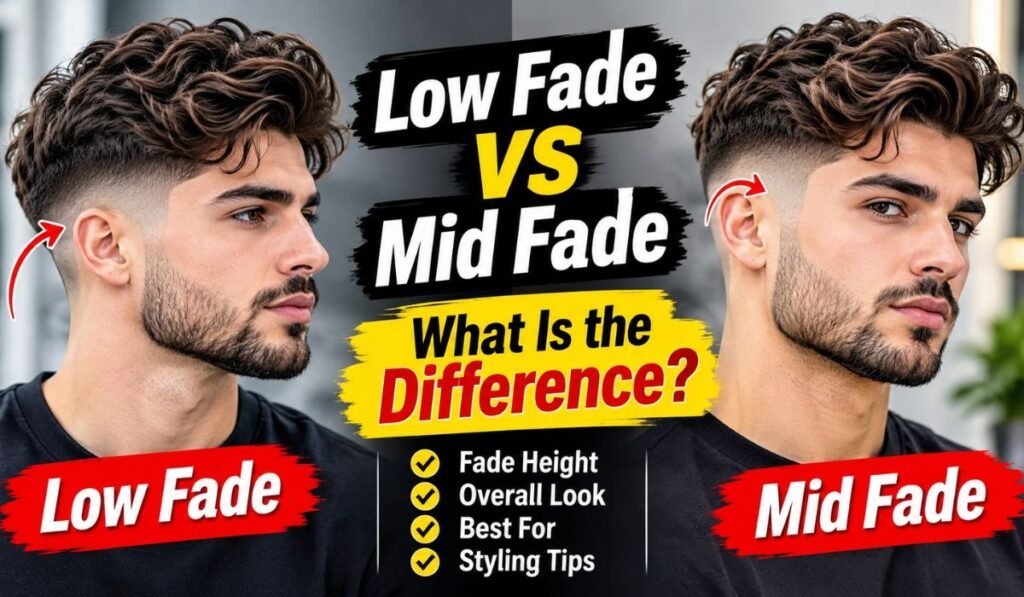
A low fade starts about an inch above the ear. A mid fade starts around the temple, roughly halfway up the side.
Low fade:
- Subtle transition, easy to wear to work.
- Keeps more hair on the sides, so it feels softer.
- Grows out gracefully.
Mid fade:
- Cleaner contrast and more visible shaping.
- Works for both professional and casual settings.
- Needs more frequent touch-ups.
If you want a safe step up from a regular haircut, choose low. If you want a visible fade without going extreme, choose mid.
Low Fade vs High Fade: What Is the Difference?

This is the biggest gap in the Low Fade vs Mid Fade vs High Fade range.
| Factor | Low Fade | High Fade |
| Starting point | Above the ear | Temple and higher |
| Style statement | Understated | Confident, edgy |
| Contrast with top | Gentle | Dramatic |
| Upkeep | Lower | Higher |
| Workplace fit | Excellent | Depends on the dress code |
A low fade frames your face without drawing attention to the sides. A high fade pulls attention to the top and makes the hair there look fuller and longer by comparison.
One practical tip: you can always go higher next time, but you can’t add hair back. If you’re nervous about a high fade, start low or mid.
Read Related Post: 20 Best Caesar Haircuts For Men In 2026
High Fade vs Mid Fade: What Is the Difference?

The gap between these two is smaller than it looks, but it shows in the details.
- Starting point: A mid fade starts at the temples. A high fade starts above them.
- Contrast: A high fade removes more hair from the sides, so the top stands out more.
- Upkeep: A mid fade gives you a few extra days before it looks overgrown.
- Versatility: A mid fade suits more face shapes and dress codes.
For most men, mid is the safe middle and high is the style choice. If you like the look of a high fade but need something more formal, a mid fade is the compromise.
Skin Fade vs High Fade: What Is the Difference?

These terms describe two different things, so they aren’t opposites.
- High fade describes where the blend starts.
- Skin fade (also called a bald fade) describes how short it ends. The fade goes all the way down to bare skin.
You can combine them. A “high skin fade” starts high and finishes at the skin, which gives the sharpest contrast possible. A “high taper fade” starts high but leaves a little length at the bottom, so it looks softer.
The same logic applies to every height. You can have a low skin fade, a mid skin fade, or a high skin fade. When you compare Low Fade vs Mid Fade vs High Fade, remember that skin or taper is a second choice you make on top of height.
Which Fade Suits Your Face Shape?
Barbers don’t all agree on this, so treat face shape as a guide, not a rule. These are the most common recommendations.
| Face Shape | Best Fade | Why It Works |
| Oval | Any height | Balanced proportions suit all three |
| Round | Mid or high | Removes side volume and adds height |
| Square | Low or mid | Keeps a strong jaw from looking too boxy |
| Long / oblong | Low | A high fade adds more height to an already long face |
| Heart | Low or mid | Keeps the sides soft and balances a narrow chin |
| Diamond | Mid or high | Trims width at the cheekbones |
Why this works: Fades change how wide or tall your head looks. Taking hair off the sides makes the face look narrower and longer. Leaving more hair on the sides adds width.
When choosing between Low Fade vs Mid Fade vs High Fade by face shape, the rule is simple: round faces gain from height, long faces gain from keeping the fade low.
Which Fade Suits Your Hair Type?
Texture affects how clean the blend looks and how fast it grows out. Thick, coarse hair shows regrowth faster. Fine hair can show scalp more easily.
Low Fade vs Mid Fade vs High Fade for Straight Hair
Straight hair shows every detail of the blend, which is good news if the barber is skilled.
- Low fade: Soft and tidy. Good for fine or thinning hair because it doesn’t expose too much scalp.
- Mid fade: The most flexible choice. It pairs well with a side part, comb-over, or textured crop.
- High fade: Gives sharp, crisp lines. Straight hair shows the contrast clearly, so keep the top styled.
Straight hair tends to lie flat, so leave enough length on top to style. A high fade with very short hair on top can look severe.
Low Fade vs Mid Fade vs High Fade for Curly Hair

Curly hair can take any of the three fades. The fade contrasts well with the texture on top.
- Low fade: Keeps the curls looking full and natural. A good first step for curly hair.
- Mid fade: Controls the sides while letting curls stand out on top.
- High fade: Creates the strongest contrast. Keep at least a few inches on top so the curls can form.
Curly and coily hair often looks best with skin or drop fades because the sharp edge shows off the curls. Find a barber who works with your texture. A fade on curly hair is harder to blend than on straight hair.
Which Fade Suits Your Lifestyle?
Think about where you spend your week, not just what looks good in a photo.
Choose a low fade if you:
- Work in a conservative setting (finance, law, corporate).
- Prefer a quiet, classic look.
- Visit the barber once a month or less.
Choose a mid fade if you:
- Want something that works at the office and on weekends.
- Like a visible fade but not a dramatic one.
- Can get a trim every two to three weeks.
Choose a high fade if you:
- Work in a creative, casual, or athletic setting.
- Want a sharp, modern style.
- Are happy to visit the barber every one to two weeks.
If you play sports, a high fade stays cooler and needs less washing. If you hate frequent appointments, go low.
What to Tell Your Barber?
Clear communication is half of a good fade. Use these steps.
- Name the height: “low fade,” “mid fade,” or “high fade.”
- Say skin or taper: “high skin fade” or “mid taper fade.”
- Give a guard number: Tell them how short the shortest part should be, or say “down to the skin.”
- State the top length: Say how much you want left on top.
- Bring a photo: Photos remove guesswork. Show the exact blend height you like.
- Mention the neckline: Ask for a tapered, rounded, or squared finish at the back.
If you’re unsure, say: “Start low and go up if it needs it.” You can’t undo a cut, but a barber can always take more off.
How Often Should You Get Each Fade?
Fades grow out quickly because the contrast between short and long hair disappears as the short part grows.
| Fade | Ideal Frequency | Notes |
| Low fade | Every 3–4 weeks | Grows out softly and stays presentable longer |
| Mid fade | Every 2–3 weeks | Looks fuzzy around week 3 |
| High fade | Every 1–2 weeks | The skin line grows out first and is easiest to notice |
If you want to stretch the time between cuts, get a low fade or a taper instead of a skin fade. Quick tidy-ups of the neckline and sideburns between full cuts help too. Thick, fast-growing hair needs earlier appointments.
Quick Decision Guide
Use this when you need an answer fast.
| If you want… | Choose |
| A safe, professional cut | Low fade |
| One cut for work and weekends | Mid fade |
| A bold, high-contrast look | High fade |
| The least upkeep | Low fade |
| To add height to a round face | Mid or high fade |
| To soften a long face | Low fade |
| The sharpest blend | High skin fade |
| A gentler grow-out | Low taper fade |
In short, choose low for subtle, mid for balanced, and high for bold. That is the whole Low Fade vs Mid Fade vs High Fade decision.
FAQ’s
What is the difference between low, mid, and high fade?
The difference is where the fade begins: just above the ear for low, at the temples for mid, and higher up the head for high.
Which fade lasts the longest?
A low fade lasts longest because it leaves more hair on the sides and grows out gradually.
Which fade is best for a round face?
A mid or high fade suits a round face because it trims side volume and adds height.
Which fade is most versatile?
The mid fade is the most versatile. It works with most hairstyles, face shapes, and dress codes.
What is the difference between a low fade and a mid taper?
A taper shortens the hair gradually and usually leaves some length at the edges. A low fade cuts much closer, often down to the skin, and covers more area.
What is the difference between a skin fade and a high fade?
A skin fade describes how short the blend ends (down to the skin). A high fade describes where it starts, so the two can be combined.
Can curly hair get any of the three fades?
Yes. Curly hair works with all three, but high and skin fades show the strongest contrast with the curls on top.
Which fade is best for straight hair?
All three work on straight hair. A mid fade is the most flexible, and a high fade gives the cleanest lines.
Conclusion
The Low Fade vs Mid Fade vs High Fade choice comes down to height, contrast, and upkeep. Low is subtle and easy to maintain. Mid is balanced and flexible. High is bold and needs the most trims.
Match the fade to your face shape, hair texture, and schedule. Then give your barber a clear brief: the height, skin or taper, and a reference photo. If you’re still unsure, start with a low or mid fade and go higher next time. Once you understand Low Fade vs Mid Fade vs High Fade, you can choose the cut that suits you instead of guessing.

Alex is a passionate hairstyle enthusiast and the creator of WowFades. He loves exploring modern haircuts, stylish hairstyles, and fresh fade trends, sharing practical inspiration to help readers discover new looks and feel confident about their personal style.









1 thought on “Low Fade vs Mid Fade vs High Fade: What’s The Difference?”