
A sharp jawline is hard to fake. A chin strap beard fakes it very well. This style traces your jaw with a clean band of hair, so it adds definition without the bulk of a full beard.
It looks simple, but it leaves no room for sloppy edges. In this guide, you’ll get 15 styles, exact trim steps, haircut pairings and the mistakes that ruin the look. Pick your version and start trimming.
What Is a Chin Strap Beard?
A chin strap beard is a narrow line of facial hair that runs along the jaw from one sideburn to the other. It usually has no mustache, and the cheeks and neck stay clean-shaven.
The strap can be as thin as 2 mm or as wide as 2 cm. The cleaner the edges, the sharper it looks.
Quick facts:
- Best for: Defining the jawline and adding structure to the lower face
- Hair length: Stubble to about 10 mm
- Maintenance: High. Edges need a touch-up every few days
- Growth time: Roughly 2 to 4 weeks for a solid strap
A well-kept chin strap beard works best when your sideburns connect cleanly to the line. Gaps near the ears are the most common weak spot.
Who should wear it?
- Men with a defined or angular jaw who want to show it off
- Men with rounder faces who want a little extra structure (use a wider strap)
- Men whose cheek hair grows in thin, since the strap only needs jaw coverage
- Anyone who prefers a tidy, low-bulk look over a full beard
Who should think twice?
- Men with a very weak chin, unless they choose an extended or goatee version
- Anyone unwilling to trim every few days, because the style falls apart quickly without upkeep
The look has been around for decades, and it keeps returning because it works with both formal and casual outfits. Add a clean shave on the cheeks and the contrast does most of the styling for you.
What Are the Best Chin Strap Beard Styles?
There is no single correct shape. The best chin strap beard depends on your face shape, beard density and how much time you want to spend grooming.
Here is a quick comparison before the full breakdown.
| Style | Width | Maintenance | Best For |
| Classic | 1–1.5 cm | Medium | Most men |
| Thin | 2–5 mm | High | Strong, angular jaws |
| Thick/Wide | 2 cm+ | Medium | Round or wide faces |
| Stubble | 1 cm | Low | Beginners |
| Faded | 1–1.5 cm | High | Modern, polished looks |
| Disconnected | Varies | Medium | Bold, fashion-forward styles |
| Extended | 2–3 cm | Medium | Short or narrow chins |
| With Goatee | 1 cm + chin | Medium | Fuller chin growth |
| With Mustache | 1 cm + lip | Medium | Men who dislike a bare lip |
| Beardstache | 1 cm + mustache | Medium | Thick mustache growers |
| Anchor | 1 cm + mustache | High | Pointed, defined looks |
| Chin Curtain | 2–4 cm | Medium | Strong cheek growth |
| For Black Men | 1–2 cm | High | Dense, coily hair |
| Patchy-Friendly | 5 mm–1 cm | Low | Uneven growth |
| Sideburn-Connected | 1 cm | Medium | Men with full sideburns |
1. Classic Chin Strap

The classic version is a uniform band, about 1 to 1.5 cm wide, running from sideburn to sideburn. Keep the hair at stubble length or up to 10 mm.
It suits almost every face shape. If you’re new to this style, start here.
2. Thin Chin Strap

This is the pencil-line version, sometimes just 2 to 5 mm wide. It’s sharp and minimal, and it highlights a strong jaw.
The catch is upkeep. One missed day and the line blurs. Use a precision trimmer and a steady hand.
Read Related Post: 20 Best Haircuts For Thick Straight Hair (2026 Styles)
3. Thick/Wide Chin Strap

A wider strap, around 2 cm or more, gives the style more presence. It balances rounder faces, where a very thin line can look too fine.
Start wide and narrow it later. You can always cut more, but you can’t add it back.
4. Stubble Chin Strap
Here the strap is kept very short, close to a day or two of growth. It looks relaxed and lived-in.
It’s the easiest version to maintain. The edges still need defining, but the shorter hair hides small errors.
5. Faded Chin Strap

The strap fades into the clean-shaven skin on the cheeks and neck instead of ending in a hard line. A barber or a good trimmer with guard lengths can do this.
It gives a softer, modern finish. Expect to refresh the fade every week.
6. Disconnected Chin Strap
In this version, the strap doesn’t link to the sideburns. It sits under the chin and along the lower jaw only, leaving a visible gap on the cheeks.
It reads as bold and deliberate. It also works if your sideburn hair is thin or patchy.
7. Extended Chin Strap

An extended strap grows longer under the chin, adding a little vertical length. Keep the sides tight and let the chin hair reach 2 to 3 cm.
Men with a short or soft chin often like this one. It makes the lower face look longer and more angular.
8. Chin Strap with Goatee
This pairs the strap with a goatee around the mouth, without a full mustache. It adds weight to the chin and fills out a longer face.
Keep the goatee shorter than you think. Too much length makes the whole look heavy.
9. Chin Strap with Mustache
Add a mustache and you have a strap that frames the whole lower face. Trim the mustache so it doesn’t reach over the lip.
It suits men who feel bare without upper-lip hair. A subtle trim keeps it from looking dated.
10. Beardstache Chin Strap
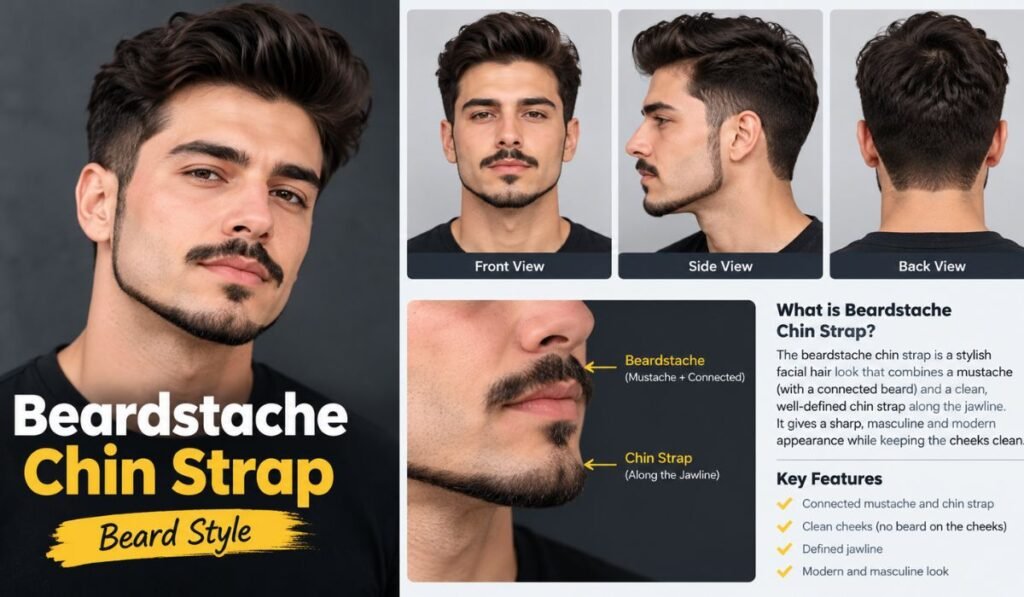
This one centers on a thick, full mustache with a trimmed strap beneath. The mustache is the focus, and the strap supports it.
It works best if your mustache grows in dense. Comb and trim it regularly to stay neat.
11. Anchor Chin Strap
The anchor combines a mustache, a soul patch and a strap that meets under the chin, forming an anchor shape. It’s sharper and more graphic than most versions.
Precision matters here. Use a detail trimmer for the narrow soul patch.
12. Chin Curtain (Amish Style)
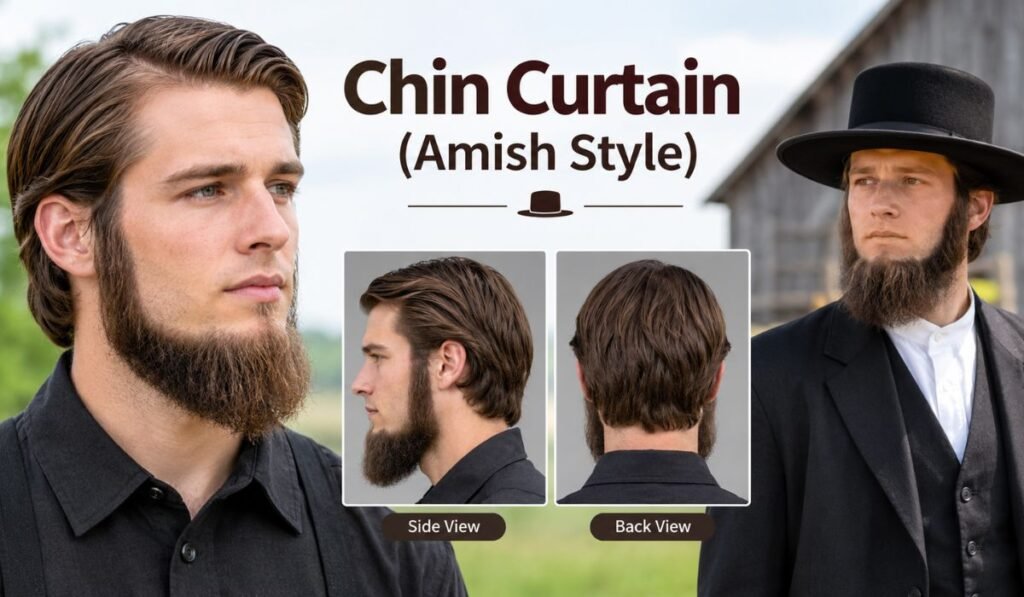
The chin curtain, also called the Shenandoah, is a full-length beard along the jaw and chin with no mustache. Abraham Lincoln wore a well-known version of it.
You can keep it long or tidy it into a shorter, more modern shape. It also hides weak growth on the upper lip.
13. Chin Strap for Black Men
Dense, coily hair holds a crisp line extremely well, so the strap can look razor-sharp. Many men keep the strap 1 to 2 cm wide for a bold effect.
Shave with the grain and moisturize afterward to reduce razor bumps. A sharp lineup from a barber helps set the shape.
14. Patchy-Friendly Chin Strap
If your beard grows unevenly, a short, thin strap along the jaw hides the gaps. Focus on the areas where hair grows strongest and skip the rest.
Keep the length short. Longer hair makes bare spots more obvious.
15. Sideburn-Connected Chin Strap

This version blends full sideburns directly into the strap, creating one continuous frame around the face. The connection must stay smooth.
It suits men with strong sideburn growth. The width of the sideburn should match the width of the strap.
Which Style Fits Your Face Shape?
Use this table to narrow your choices.
| Face Shape | Recommended Style | Why It Works |
| Oval | Classic or thin | Balanced faces suit most widths |
| Round | Thick, extended or with goatee | Adds length and angles |
| Square | Classic or faded | Softens strong corners without hiding them |
| Long | Wide or stubble | Avoids adding extra length |
| Heart | Extended or with goatee | Adds weight to a narrow chin |
How Do You Trim a Chin Strap Beard?
Trimming a chin strap beard takes about 10 to 15 minutes once you know the steps. You need a beard trimmer with guards, a precision or detail trimmer, a razor, a comb and a mirror.
Follow these steps in order.
- Grow it out. Let your beard reach 1 to 2 weeks of even growth so you have material to shape.
- Comb the hair. Brush it in the direction it grows so every hair stands at the same height.
- Set an even length. Use a guard of about 3 to 5 mm and trim the whole beard evenly.
- Mark the sideburns. Decide where the strap meets your sideburns, near the ear.
- Draw the top line. Using the detail trimmer, carve a straight line along the jaw. Pick the width you want, from 5 mm to 2 cm.
- Mark the bottom line. Repeat along the underside of the jaw, working toward the center of the chin. Keep both sides matched.
- Shave the cheeks and neck. Remove all the hair outside the strap with a razor or foil shaver.
- Check symmetry. Step back from the mirror. Fix any uneven spots in small passes.
- Moisturize. Apply a light moisturizer or beard oil to calm the skin.
Pro tips:
- Start wider than you think you need. Narrowing is easy, widening isn’t.
- Keep the neck hair shorter than the chin hair, since neck hair tends to grow thicker.
- Trim every 3 to 7 days to keep the edges crisp.
- Shave after a warm shower, when the skin is soft.
- Replace razor blades often. Dull blades tug the hair and cause bumps along the jaw.
- Use a light aftershave balm with no alcohol to calm irritation.
How to keep your chin strap beard fresh between trims:
- Comb it daily so the hair lies flat and even.
- Wash it with a mild face wash, not harsh soap.
- Apply a few drops of beard oil to prevent dry, flaky skin under the strap.
- Do a quick edge cleanup with a detail trimmer every two or three days.
- Keep your trimmer clean and oiled so the lines stay precise.
Good habits matter as much as good tools. A strap that gets small, regular touch-ups looks far better than one that gets a big fix once a week. Treat your chin strap beard like a haircut that needs steady care, and it will stay sharp.
Recommended Trimmer Guard Lengths
| Look | Guard Length |
| Stubble strap | 1–2 mm |
| Classic strap | 3–5 mm |
| Fuller strap | 6–10 mm |
| Chin curtain | 10 mm or more |
What Haircuts Work Best with a Chin Strap?
Your haircut and beard should work as one look. A clean, structured cut pairs well with a precise chin strap beard because both rely on sharp lines.
- Fade or skin fade: The cleanest match. The faded sides flow naturally into the strap.
- Undercut: Gives a bold contrast. Works best with thick strap styles.
- Quiff or pompadour: Adds height and balances the strap along the jaw.
- Crew cut: Simple, low-maintenance and easy to keep neat.
- Textured crop: A relaxed option that softens the strap’s sharpness.
- Buzz cut: Highlights the jawline. Pair it with a classic or thick strap.
If your hair is curly or wavy, keep the top voluminous and the sides short. The contrast frames the strap well.
What Are the Most Common Chin Strap Mistakes?
Most bad straps come from the same few errors. Avoid these and you’ll look better than most.
- Uneven width. The strap grows wider on one side. Check both sides after every pass.
- A line that’s too thin. Very thin straps look harsh on round or soft faces.
- Ignoring the neckline. Leaving neck hair makes the whole style look messy.
- Skipping regular touch-ups. A chin strap beard blurs within days if you don’t maintain it.
- Cutting too fast. Rushing leaves gaps you can’t undo.
- Using the wrong tool. A regular trimmer is too blunt for fine edges. Use a precision trimmer.
- Forgetting skin care. Frequent shaving causes irritation. Moisturize every time.
- Choosing the wrong style for your face shape. Use the table above before you commit.
FAQ’s
What is a chin strap beard called?
It’s also called a chinstrap or jawline beard. A wider, longer version is called a chin curtain or Shenandoah.
Does a chin strap beard look professional?
Yes, when it’s kept neat. A trimmed strap with crisp edges looks polished at work.
How long does it take to grow a chin strap beard?
Most men need about 2 to 4 weeks. Thicker versions can take longer.
Can you have a chin strap with a patchy beard?
Yes. Choose a thin or short strap along the jaw where hair grows best.
How wide should a chin strap beard be?
Most men do well with 1 to 1.5 cm. Go thinner for angular faces and wider for round ones.
Conclusion
The best chin strap beard is the one that fits your face, your hair type and your routine. Start with a classic width, trim it evenly, and keep the edges clean.
Once you’re comfortable, try a fade, a goatee or a chin curtain. Use the style table to choose, follow the trim steps, and touch up often. A little precision is all this look needs to stand out in 2026.

Alex is a passionate hairstyle enthusiast and the creator of WowFades. He loves exploring modern haircuts, stylish hairstyles, and fresh fade trends, sharing practical inspiration to help readers discover new looks and feel confident about their personal style.



1 thought on “15 Best Chin Strap Beard Styles with Trim Guide (2026)”