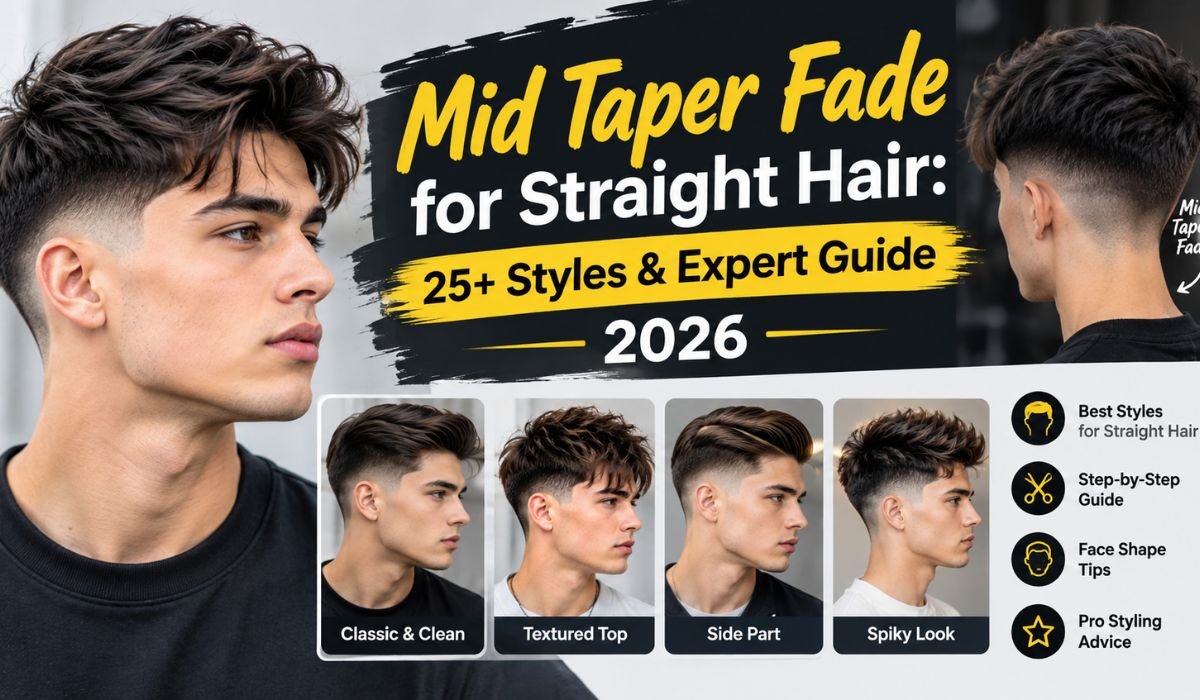
If you’ve got straight hair and you’re hunting for a cut that’s sharp, low-maintenance, and endlessly versatile, the Mid Taper Fade for Straight Hair deserves the top spot on your list. It’s the haircut barbers recommend most often because it blends structure with natural movement — no curl pattern required to make it pop.
This guide breaks down everything: what the cut actually is, how it compares to low and high tapers, 25+ style variations, styling routines, product picks, face-shape matching, maintenance timelines, pricing, and answers to the questions people ask most.
What Is a Mid Taper Fade for Straight Hair and Why Does It Look So Sharp?
A Mid Taper Fade for Straight Hair starts its blend around the middle of the head — roughly between the temple and the ear — and gradually tapers down to shorter lengths near the neckline. Because straight strands lie flat against the scalp, the transition line reads as crisp and continuous rather than broken up by curl or wave pattern.
That’s the core reason this cut looks so sharp on straight textures: there’s nothing interrupting the visual line of the fade. The eye travels smoothly from the longer top to the tapered sides, which is exactly what gives the style its clean, tailored appearance.
What is a mid-taper fade for Straight Hair?
In simple terms, a mid taper fade for straight hair is a fade haircut where:
- The fade begins mid-way up the side of the head (not high near the crown, not low near the ear)
- The top length typically ranges from 1 to 4 inches, depending on the style
- The sides blend gradually rather than dropping sharply to skin
- Straight hair texture allows the fade line and the top styling to both stay crisp and defined
It sits right in the middle of the fade spectrum — more contrast than a low fade, softer than a high fade — which is why it works for almost any face shape, hair density, and lifestyle.
Why Straight Hair Is Actually Perfect for a Mid Taper Fade
Straight hair has a reputation for being “boring,” but for this specific cut, that flatness is an advantage:
- Clean fade lines — straight strands don’t puff or curl over the blend, so the taper line stays visible and sharp
- Predictable styling — what you see right after a cut is close to what you’ll get every morning
- Works with or without product — a quick blow-dry or a dab of clay is often all you need
- Highlights precision cutting — barbers can show off sharp parting, disconnection, or texture work because straight hair holds the shape
In short, the Mid Taper Fade for Straight Hair turns a texture people sometimes see as plain into a canvas for sharp, structured styling.
Read Related Post: High Blowout Taper Haircut Guide: Low vs Mid vs High, Every Hair Type
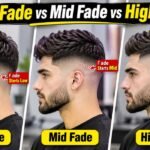
Mid Taper vs Low Taper vs High Taper – Which Is Best for Straight Hair?
Choosing between taper heights comes down to how much contrast you want and how much length you want to keep on top.
| Taper Type | Fade Start Point | Contrast Level | Best For |
| Low Taper | Just above the ear | Subtle | Office settings, first-time fades, mature styles |
| Mid Taper | Mid-way up the side | Balanced | Most face shapes, everyday versatility |
| High Taper | Near the crown | Bold | Statement looks, thicker hair, younger styling |
Low Taper Fade for Straight Hair
A low taper keeps most of the sides longer, with the fade beginning just above the ear. On straight hair, this creates a subtle, professional look with minimal contrast — ideal for conservative workplaces.
Mid Taper Fade for Straight Hair
This is the sweet spot. A mid taper fade for straight hair offers enough contrast to look intentional and modern without going overboard. It suits nearly every face shape and pairs well with almost any top style, from textured fringe to a slicked-back finish.
High Taper Fade for Straight Hair
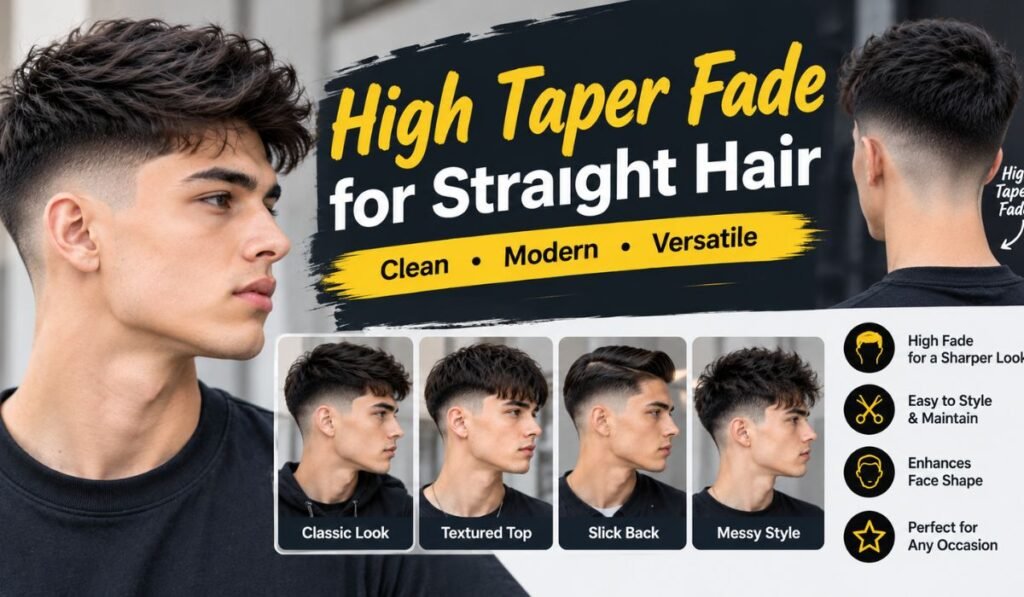
Starting near the crown, a high taper creates the boldest contrast between the top and sides. It works best on thicker straight hair that can hold volume on top to balance the shorter sides.
25+ Best Mid Taper Fade Styles for Straight Hair in 2026
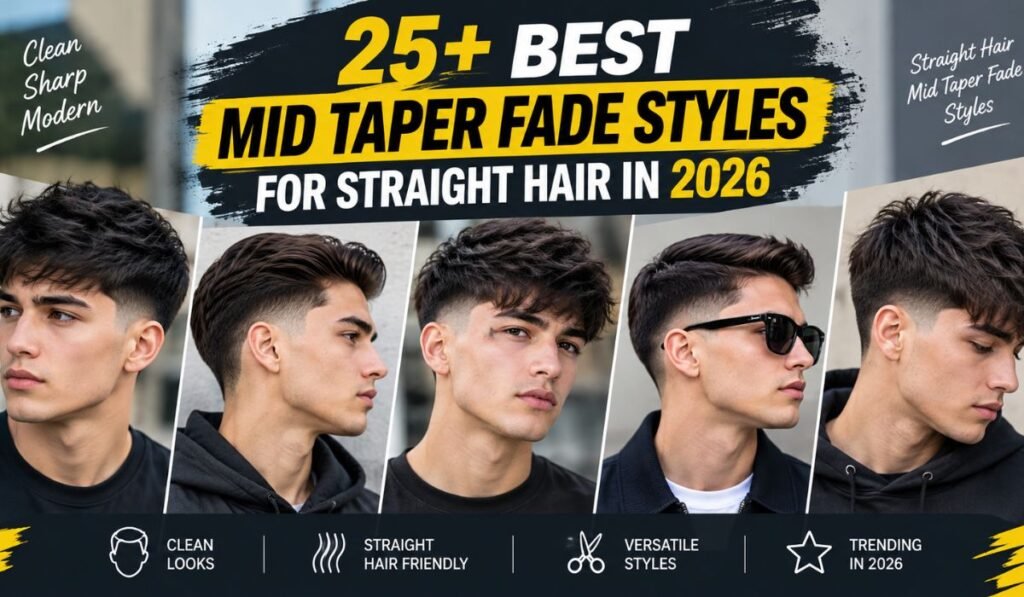
Below are the most requested variations of the Mid Taper Fade for Straight Hair this year, from classic to bold.
1. Classic Mid-Taper Fade Straight Hair
The timeless version — even length on top, clean taper on the sides, minimal styling required.
2. Textured Fringe Mid-Taper Fade Straight Hair
Choppy, layered fringe adds movement up top while the taper keeps things tidy underneath.
3. Messy Fringe Mid-Taper Fade Straight Hair
A more undone, tousled take on the fringe — great for casual, everyday wear.
4. Mid-Blowout Taper Fade Straight Hair
Height and volume created with a round brush blow-dry, paired with a tapered side for contrast.
5. Curtain Bangs Mid Taper Fade Straight Hair
Center-parted strands fall softly on either side of the face, framed by a clean taper.
6. Slick Back Mid Taper Fade Straight Hair
Top hair combed straight back with a strong-hold product; polished and professional.
7. Comb-Over Mid-Taper Fade Straight Hair
A defined side part with hair swept across, blending smoothly into the taper.
8. Hard Part Mid Taper Fade Straight Hair
A shaved line accentuates the part, giving the comb-over extra sharpness.
9. French Crop Mid Taper Fade Straight Hair
Short, textured fringe with a blunt edge — low maintenance and always in style.
10. Pompadour Mid Taper Fade Straight Hair
Lifted, swept-back volume on top contrasted against a clean taper for a bold, retro-modern look.
11. Mid Taper Fade for Asian Straight Hair
Works especially well with naturally dense, straight Asian hair, which holds textured fringe and volume beautifully.
12. Mid Taper Fade for Thin Straight Hair
Shorter top lengths and strategic layering create the illusion of extra density.
13. Mid Taper Fade for Thick Straight Hair
Thinning shears and longer top lengths help manage bulk while keeping the silhouette clean.
14. Disconnected Mid Taper Fade Straight Hair
A sharp, visible break between the top length and the tapered sides for an edgy contrast.
15. Edgar Cut Mid Taper Fade Straight Hair
A blunt, straight-across fringe paired with a rounded taper — a viral favorite.
16. Crew Cut Mid-Taper Fade Straight Hair
Short, uniform length on top with a subtle taper; the ultimate low-maintenance option.
17. Quiff Mid Taper Fade Straight Hair
Top hair pushed up and back for height, tapered sides keep it grounded and sharp.
18. Ivy League Mid Taper Fade Straight Hair
A slightly longer, classic crew cut variation with more styling flexibility on top.
19. Side Part Mid Taper Fade Straight Hair
A defined, combed part paired with a clean taper — versatile for formal and casual settings.
20. Faux Hawk Mid Taper Fade Straight Hair
Center strip styled upward for a subtle mohawk effect, framed by tapered sides.
21. Spiky Top Mid Taper Fade Straight Hair
Short, gel-defined spikes on top add texture and edge to the taper.
22. Caesar Cut Mid Taper Fade Straight Hair
Short, forward-styled fringe combined with a subtle taper — clean and understated.
23. Mid Taper Fade with Beard: Straight Hair
Pairing the taper with a well-groomed beard creates a balanced, masculine frame for the face.
24. Long Top Mid Taper Fade Straight Hair
Extra length on top (3-5 inches) allows for slick styles, waves, or brushed-back looks.
25. Modern Mullet Mid Taper Fade Straight Hair
Shorter sides via the taper contrast with longer back length for a contemporary mullet twist.
How to Style Mid Taper Fade Straight Hair: Step-by-Step
Daily Styling Routine for Mid-Taper Fade Straight Hair
- Start with slightly damp hair
- Apply a small amount of product (clay, cream, or paste depending on desired finish)
- Use fingers or a comb to shape the top
- Blow-dry briefly for hold, or air-dry for a more natural look
- Finish with a light texturizing spray if extra grip is needed
Blow-Drying Technique for Volume on Straight Hair
Point the dryer at the roots while lifting hair with a round brush in the opposite direction of hair growth. This builds volume that straight hair otherwise lacks naturally.
Creating Texture on Naturally Flat Straight Hair
- Use a matte clay or texture powder, not a shiny gel
- Apply product to dry hair and work in with fingertips, not a comb
- Focus on separating strands rather than smoothing them down
Styling for Different Occasions
| Occasion | Recommended Style |
| Office/Formal | Side part or slick back |
| Casual/Everyday | Textured fringe or messy fringe |
| Night Out | Pompadour or quiff |
| Workout/Active | Crew cut or French crop |
Best Products for Mid Taper Fade on Straight Hair
Best Matte Clays for Straight Hair
Matte clay gives a strong, non-shiny hold — ideal for textured fringes and disconnected styles.
Best Styling Creams for Straight Hair
Lighter creams offer flexible hold with a natural sheen, best for slick backs and side parts.
Best Texture and Volume Products for Straight Hair
Sea-salt sprays and texture powders add grip and lift, helping straight hair hold shape longer through the day.
Which Face Shape Suits a mid-taper fade straight hair best?
Oval Face Shape
Nearly every variation works well; oval faces have the most flexibility with top length and fade height.
Round Face Shape
Choose styles with height on top (quiff, pompadour) to elongate the face and avoid excess width on the sides.
Heart Face Shape
Side-swept fringe or a side part balances a narrower chin against a broader forehead.
Square Face Shape
Textured, slightly longer tops soften strong jawlines; avoid overly blunt, geometric fringes.
Diamond Face Shape
Fringe styles that add width at the forehead help balance narrow cheekbones.
Mid Taper Fade for Thin vs Thick Straight Hair: Key Differences
Thin Straight Hair: What to Do Differently
- Keep the top shorter to avoid a flat, limp look
- Use volumizing products, not heavy creams
- Ask your barber for point-cutting to add texture and fake density
Thick Straight Hair: What to Do Differently
- Request thinning shears to reduce bulk
- Longer top lengths are manageable and won’t feel heavy
- Matte clay controls thickness better than lightweight sprays
How to Ask Your Barber for a Mid Taper Fade on Straight Hair
Walk in with a clear, simple request:
- “I’d like a mid taper fade — start the blend around mid-height on the sides”
- Specify your desired top length in inches
- Mention your hair type (“my hair is straight, so I want the fade line to stay crisp”)
- Bring a reference photo if you have one; straight hair photographs the fade clearly, which helps communicate the exact look
Mid Taper Fade Maintenance Schedule and Growth Timeline
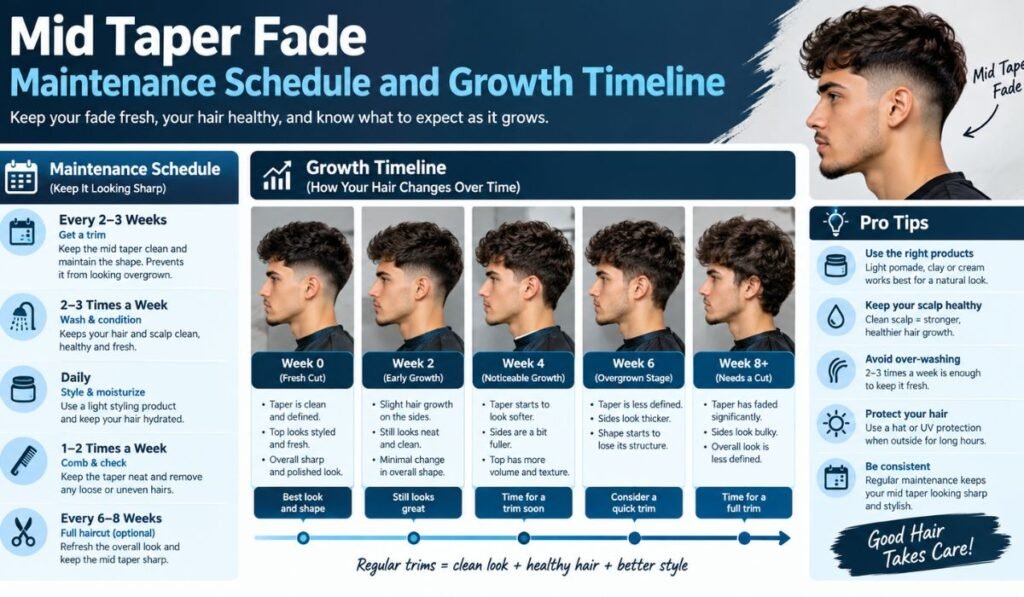
Professional Touch-Up Schedule
Get the fade refreshed every 2-3 weeks to keep the blend sharp, since straight hair shows regrowth at the taper line quickly.
Week-by-Week Growth Timeline
- Week 1-2: Fade line stays crisp, minimal styling adjustment needed
- Week 3-4: Fade begins to soften; top length grows noticeably
- Week 5-6: Style transitions toward a longer, more textured look — good time for a touch-up or a full restyle
Between-Visit Home Maintenance
Trim any stray flyaways with small scissors and use a light product to keep the fade line looking intentional between barber visits.
Common Mistakes to Avoid with Mid Taper Fade on Straight Hair
- Skipping regular touch-ups, which lets the fade line blur
- Using heavy, greasy products that weigh straight hair down
- Choosing a top length too long for thin hair, causing it to look flat
- Not communicating clearly with your barber about fade height
- Overusing heat tools without heat protection, leading to dryness
How Much Does a Mid Taper Fade for Straight Hair Cost?
Pricing varies by location and barber experience, but here’s a general range:
| Service Level | Typical Price Range |
| Budget/Student Barber | 20-30 |
| Standard Barbershop | 35-50 |
| Premium/Master Barber | 50-80+ |
Adding a beard trim usually adds 10-20 to the total cost.
FAQ’s
Is a mid-taper fade good for straight hair?
Yes — straight hair produces one of the cleanest, sharpest fade lines of any hair type, making the mid taper fade especially effective.
How often should I get a mid-taper fade touched up?
Every 2-3 weeks keeps the blend looking fresh and defined.
What products work best for a mid taper fade on straight hair?
Matte clays and lightweight creams work best; avoid heavy, greasy formulas.
What’s the difference between a mid taper and a low taper for straight hair?
A mid taper starts higher on the head and creates more contrast than a low taper, which begins just above the ear.
What face shapes suit a mid taper fade best?
Oval faces suit nearly every variation, while round, square, heart, and diamond shapes benefit from specific top-length adjustments.
Can I get a mid taper fade on thin straight hair?
Yes — keep the top shorter and use volumizing products to avoid a flat appearance.
How do I style a mid taper fade for volume on straight hair?
Blow-dry at the roots with a round brush, lifting against the direction of hair growth.
What exactly do I say to my barber?
Ask for a mid taper fade, specify your desired top length, and mention that your hair is straight so they can keep the fade line crisp.
Will a mid-taper fade look good as it grows out on straight hair?
Yes, though the blend softens after 3-4 weeks; a touch-up keeps it sharp longer.
What’s the difference between a taper and a fade for straight hair?
A taper gradually shortens hair without going to skin, while a fade blends down to skin at some point on the sides.
Conclusion
The Mid Taper Fade for Straight Hair earns its popularity honestly — it’s sharp, adaptable, and works with straight texture rather than against it. Whether you want a low-maintenance crew cut or a bold disconnected fringe, this cut has a version for nearly every face shape, hair density, and lifestyle. Bring a clear reference to your barber, stick to a 2-3 week touch-up schedule, and you’ll keep this style looking crisp all year.

Alex is a passionate hairstyle enthusiast and the creator of WowFades. He loves exploring modern haircuts, stylish hairstyles, and fresh fade trends, sharing practical inspiration to help readers discover new looks and feel confident about their personal style.






1 thought on “Mid Taper Fade for Straight Hair: 25+ Styles & Expert Guide 2026”